
Hoarding Cleanup Cost Irvine | Get Complete Hoarding Services by JunkOUT
If you’re reading this article, you or someone you care about may be facing the overwhelming challenge of hoarding disorder — a recognized mental health condition that affects an estimated 2-6% of the U.S. population. In Orange County alone, that’s potentially 60,000-180,000 individuals and families struggling with compulsive acquisition and difficulty discarding possessions.
Whether you’re a family member seeking help for a loved one, a property manager dealing with a hoarding situation in an Irvine Company apartment, or someone personally facing this challenge, know this: You are not alone. Hoarding disorder is a medical condition, not a character flaw. Help is available, and recovery is possible.
This guide will walk you through the true costs of hoarding cleanup in Irvine — not just financial, but emotional, practical, and logistical. More importantly, we’ll share resources, support options, and a compassionate approach to what many consider one of life’s most difficult challenges.
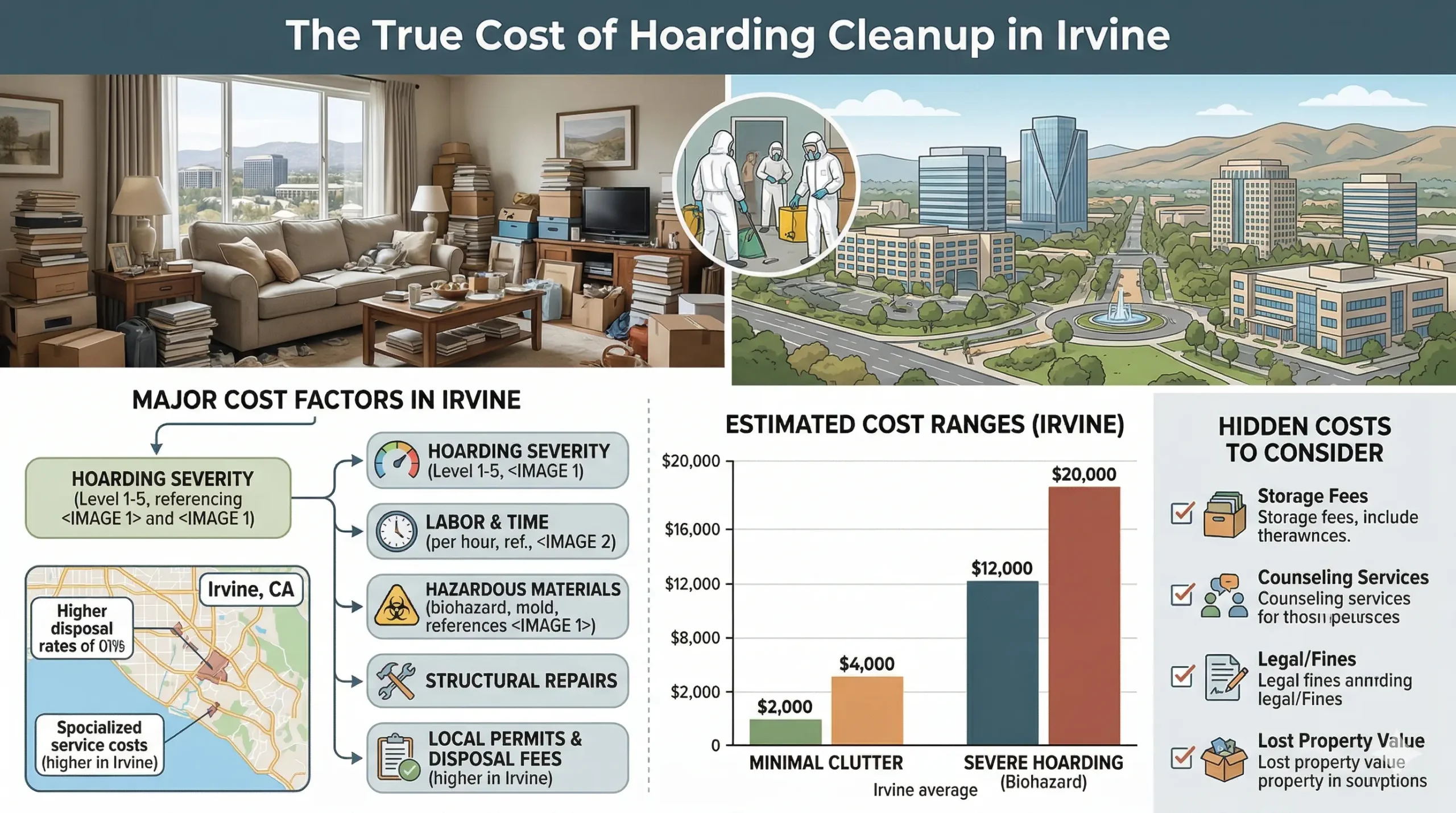
Quick Answer: Professional hoarding cleanup in Irvine typically costs $2,000-$15,000+ depending on severity (measured by the Clutter Image Rating scale, levels 1-5), home size, and hazards present. However, the true cost includes mental health support, family counseling, and ongoing maintenance plans. Successful hoarding intervention requires a team approach: therapist, professional organizer, cleanup crew, and supportive family/friends working together with patience and compassion.
💙 A Note on Language & Compassion
Throughout this guide, we use person-first language (“person with hoarding disorder” rather than “hoarder”) because hoarding is a condition someone has, not who they are. We also acknowledge that cleanup is just one part of a larger journey toward recovery. Our goal is to provide practical information while honoring the dignity, autonomy, and humanity of everyone affected by this disorder.
🧠 Understanding Hoarding Disorder: More Than Just Clutter
Hoarding disorder was officially recognized as a distinct mental health condition in the DSM-5 (Diagnostic and Statistical Manual of Mental Disorders) in 2013. It’s characterized by:
- Persistent difficulty discarding possessions regardless of their actual value
- Perceived need to save items and distress associated with discarding them
- Accumulation of possessions that congests and clutters living areas, substantially compromising their intended use
- Significant impairment in social, occupational, or other important areas of functioning (including maintaining a safe environment)
What Hoarding Is NOT
It’s important to distinguish hoarding disorder from:
- ✅ Collecting: Collectors acquire specific items intentionally and display them with pride. Hoarding is chaotic and distressing.
- ✅ Clutter: Temporary disorganization is normal. Hoarding is persistent and worsens over time without intervention.
- ✅ Laziness or “being messy”: Hoarding is a complex mental health condition, often related to trauma, anxiety, depression, or ADHD.
- ✅ A choice: People with hoarding disorder don’t choose to live this way. The compulsion is real and distressing.
The Clutter Image Rating (CIR) Scale
Mental health professionals and cleanup specialists use the Clutter Image Rating scale to assess hoarding severity. Understanding this scale helps families and professionals communicate and plan appropriate interventions:
| Level | Description | Safety Concerns | Typical Cleanup Cost |
|---|---|---|---|
| Level 1 | Light clutter, all doors/stairways accessible, no odors, home is sanitary and safe | Minimal | $1,000-$3,000 |
| Level 2 | One major exit blocked, light mold, clutter in 2+ rooms, overflowing garbage, pet waste present | Moderate — fire hazard, sanitation issues | $2,000-$6,000 |
| Level 3 | One bedroom/bathroom unusable, light pest infestation, strong odors, excessive dust, soiled clothing, dirty dishes | High — pest issues, unsanitary conditions | $4,000-$10,000 |
| Level 4 | Structural damage, sewage issues, hazardous materials, heavy pest infestation, 2+ rooms unusable, rotting food | Severe — health hazards, fire danger, structural risks | $8,000-$20,000+ |
| Level 5 | No electricity/water, severe structural damage throughout, fire hazard present, human/animal waste, heavy rodent infestation | Critical — immediate danger, often uninhabitable | $15,000-$50,000+ |
⚠️ Important: Levels 4-5 hoarding situations often require specialized biohazard cleanup teams, structural engineers, and coordination with local health departments. These are not DIY situations and should never be approached without professional help and safety equipment.
📚 Orange County Mental Health Resources for Hoarding Disorder
- International OCD Foundation (IOCDF) Hoarding Center: hoarding.iocdf.org — Find OC therapists specializing in hoarding disorder
- Hoarding Disorder Support Group (Orange County): Monthly meetings at OC Health Care Agency — Call (855) 625-4657
- Orange County Mental Health Association: (714) 544-2500 — Referrals to local therapists
- NAMI Orange County (National Alliance on Mental Illness): namioc.org — (714) 544-5448
- UCI Health Psychiatry: (714) 456-7002 — Comprehensive mental health services
- 211 Orange County: Dial 211 — Free referrals to mental health, housing, and emergency services
💰 The True Cost of Hoarding Cleanup in Irvine
When families ask “How much does hoarding cleanup cost?”, they’re often focused on the financial aspect. But the true cost is multifaceted and includes financial, emotional, time, and health-related factors.
1. Financial Costs (What You’ll Pay)
Professional Hoarding Cleanup Services in Irvine:
| Service Component | Typical Cost Range | Notes |
|---|---|---|
| Initial Assessment & Planning | $0-$300 | Many companies offer free estimates; therapists may charge consultation fees |
| Professional Organizer (Hoarding Specialist) | $75-$150/hour | Essential for decision-making process, typically 20-100+ hours |
| Junk Removal & Hauling (Level 1-2) | $2,000-$6,000 | Standard removal, sorting, donation coordination |
| Junk Removal & Hauling (Level 3-4) | $6,000-$15,000 | Heavy lifting, extensive sorting, multiple truck loads |
| Biohazard Cleanup (if needed) | $3,000-$10,000+ | Human/animal waste, mold remediation, pest treatment |
| Pest Control & Extermination | $500-$3,000 | Depends on infestation severity |
| Deep Cleaning & Sanitization | $1,000-$5,000 | After junk removal, professional cleaning required |
| Repairs & Restoration | $2,000-$50,000+ | Structural repairs, flooring, drywall, plumbing, electrical |
| Dumpster Rental (if needed) | $400-$800/week | 10-40 yard dumpsters for DIY sorting |
| Storage Units (temporary) | $100-$400/month | For items being sorted or kept during cleanup |
| Therapy/Counseling (ongoing) | $100-$250/session | Essential for long-term recovery, typically weekly for months/years |
Total Typical Range for Complete Hoarding Intervention in Irvine:
- Level 1-2: $3,000-$10,000
- Level 3: $8,000-$20,000
- Level 4-5: $15,000-$75,000+
💡 Insurance & Financial Assistance: Some homeowner’s insurance policies may cover portions of hoarding cleanup, especially if there’s documented damage (water, fire, pest infestation). Medi-Cal may cover mental health treatment. Some nonprofits offer financial assistance for low-income seniors. Always ask and advocate for coverage — don’t assume it’s not covered.
2. Emotional & Psychological Costs
The emotional toll of hoarding cleanup is often more significant than the financial cost:
- Grief and loss: Letting go of possessions triggers genuine mourning, even for items others see as trash
- Shame and embarrassment: Many people with hoarding disorder have hidden their condition for years, fearing judgment
- Family conflict: Disagreements about pace, what to keep, and process can strain relationships
- Anxiety and overwhelm: The sheer magnitude of the task can trigger panic, paralysis, or shutdown
- Decision fatigue: Making thousands of keep/discard decisions is mentally exhausting
- Trauma re-triggering: Hoarding often stems from past trauma; cleanup can bring buried emotions to surface
💙 Why Compassion Matters More Than Speed
Well-meaning family members often want to “just clean it all out” while the person is away. This approach almost always backfires. Forced cleanouts without the person’s consent and participation lead to:
- Severe psychological trauma and trust violations
- Immediate re-accumulation (often worse than before)
- Damaged family relationships that may never fully heal
- Increased isolation and shame
The only sustainable approach involves the person with hoarding disorder as an active, respected participant in their own recovery. This takes longer but has infinitely better outcomes.
3. Time Costs
Hoarding cleanup is not a weekend project. Realistic timelines:
- Level 1-2: 2-6 weeks of consistent work (10-20 hours/week with professional help)
- Level 3: 2-4 months of regular sessions
- Level 4-5: 4-12+ months, depending on cooperation, resources, and support
This includes sorting, decision-making, removal, cleaning, and repairs. Recovery and maintenance are lifelong processes.
4. Health & Safety Costs
Hoarding creates serious health risks that may require medical intervention:
- Respiratory issues: Mold, dust, pest droppings (treatment: $500-$5,000+)
- Injuries from falls: Cluttered pathways increase fall risk, especially for elderly individuals
- Foodborne illness: Rotting food, pest contamination
- Chronic stress: Living in hoarding conditions takes a severe toll on physical health
- Fire risk: Extreme fire hazard from blocked exits and flammable materials
❤️ Compassionate Hoarding Cleanup in Irvine
JunkOut Irvine has experience with hoarding situations throughout Orange County. We work at YOUR pace, with YOUR involvement, and with complete discretion. We coordinate with therapists, organizers, and family members to ensure a respectful, dignified process.
What makes us different: We never judge. We never rush. We never make decisions without your input. We treat every item with respect and every person with dignity.
Call (949) 556-3600 for Confidential Consultation🛠️ The Hoarding Cleanup Process: A Compassionate Roadmap
Successful hoarding cleanup follows a structured, person-centered approach. Here’s what to expect:
Phase 1: Assessment & Team Building (1-2 weeks)
Initial Steps
- Connect with a therapist who specializes in hoarding disorder (IOCDF-certified preferred)
- Assess the situation using the Clutter Image Rating scale
- Identify safety hazards requiring immediate attention (blocked exits, fire hazards, pest infestations)
- Assemble your team: Therapist, professional organizer (hoarding specialist), cleanup crew, supportive family/friends
- Obtain necessary permissions: If renter, notify landlord; if owned, consider code compliance requirements
- Develop a preliminary plan with realistic goals and timeline
Key principle: The person with hoarding disorder must be involved in every decision. This is THEIR recovery, and autonomy is essential for lasting change.
Phase 2: Safety & Stabilization (1-4 weeks)
Before deep cleanup can begin, critical safety issues must be addressed:
- ✅ Clear primary pathways (entrance to exit, bedroom to bathroom)
- ✅ Remove immediate fire hazards (piles near stove, heaters, electrical outlets)
- ✅ Address pest infestations (professional extermination if needed)
- ✅ Restore basic utilities if compromised
- ✅ Remove rotting food & biohazards
- ✅ Create one clean, functional space (often bedroom or bathroom) as a “safe zone”
💡 The “One Room” Strategy: Many therapists recommend starting with ONE room that matters most to the person (often their bedroom). Fully clearing, cleaning, and restoring this space creates a tangible win, demonstrates what’s possible, and provides a retreat space during the stressful cleanup process. This builds momentum and hope.
Phase 3: Sorting & Decision-Making (Weeks to Months)
This is the longest, most emotionally challenging phase. Professional organizers use several strategies:
The Four-Category System:
- Keep (and have a place for)
- Donate/Sell
- Recycle
- Trash
Decision-Making Guidelines:
- “Do I use this regularly?” (within past year)
- “Does this item serve a current purpose in my life?”
- “Would I buy this again if I didn’t own it?”
- “Do I have multiples of this? How many do I reasonably need?”
- “Am I keeping this out of guilt, obligation, or ‘just in case’?”
💙 Respecting Attachment & Allowing Grief
People with hoarding disorder often form emotional attachments to objects in ways that neurotypical individuals don’t fully understand. Statements like “It’s just trash!” are invalidating and harmful. Instead, professionals use phrases like:
- “Tell me about this item. What does it mean to you?”
- “I can see this is difficult. Let’s take a break.”
- “Would it help to take a photo before letting this go?”
- “You’re doing hard work. This takes real courage.”
Crying, frustration, and hesitation are normal and should be met with patience, not pressure.
Phase 4: Removal & Disposal
Once sorting decisions are made, professional junk removal teams handle:
- ✅ Heavy lifting and hauling (no stairs, tight spaces, or physical demands on family)
- ✅ Donation coordination (taking items to Goodwill, Habitat ReStore, etc.)
- ✅ Recycling (electronics, metals, paper, plastics per CA law)
- ✅ Proper disposal (landfill for items that can’t be donated/recycled)
- ✅ Biohazard removal if needed (separate specialized service)
Phase 5: Deep Cleaning & Restoration
After junk removal, the home needs thorough cleaning and possible repairs:
Cleaning Checklist
- Professional deep cleaning (floors, walls, ceilings, windows)
- Carpet cleaning or replacement (if heavily soiled or damaged)
- Pest treatment follow-up
- Mold remediation (if present)
- Odor removal (may require professional ozone treatment or sealing)
- HVAC cleaning & filter replacement
- Appliance cleaning & testing
Repair Checklist
- Structural damage repair (walls, floors, ceilings)
- Plumbing repairs (if neglected or damaged)
- Electrical repairs (outlets, switches, fixtures)
- Door/window repairs
- Paint & cosmetic repairs
Phase 6: Maintenance & Relapse Prevention (Ongoing)
The work doesn’t end when the home is clean. Ongoing support is essential to prevent re-accumulation:
- Continued therapy: Weekly or bi-weekly sessions, indefinitely
- Support groups: Monthly hoarding disorder support groups in Orange County
- Regular check-ins: Professional organizer visits every 1-3 months
- New habits & systems: Mail management, shopping limits, one-in-one-out rules
- Family support: Educated, patient family members who understand relapse is part of recovery
📚 Recommended Reading & Resources
- “Buried in Treasures” by David F. Tolin, Randy O. Frost, Gail Steketee — Workbook-style guide for people with hoarding disorder
- “Stuff: Compulsive Hoarding and the Meaning of Things” by Randy O. Frost & Gail Steketee — Understanding the psychology of hoarding
- “The Hoarder in You” by Dr. Robin Zasio — Accessible, compassionate overview
- Hoarding Cleanup Podcast: Available on most podcast platforms — Stories, tips, professional insights
- IOCDF Hoarding Resource List: hoarding.iocdf.org/professionals
🤝 We Work WITH You, Not For You
Hoarding cleanup is a collaborative process. JunkOut Irvine never makes decisions without your input, never forces timelines, and never judges your attachments or pace. We’ve helped hundreds of Orange County families navigate this difficult journey with dignity and respect.
👨👩👧👦 For Family Members: How to Help a Loved One with Hoarding Disorder
If you’re reading this because someone you love is struggling with hoarding disorder, you’re likely feeling a complex mix of emotions: frustration, worry, helplessness, anger, grief, and love all at once. These feelings are completely valid.
Here’s what you need to know about supporting someone with hoarding disorder:
What NOT to Do (Even Though You’ll Be Tempted)
⚠️ These Approaches WILL Backfire:
- ❌ Cleaning out their space while they’re away (“I’ll just do it while they’re on vacation”)
- ❌ Throwing away their possessions without permission (“They won’t even notice it’s gone”)
- ❌ Shaming or criticizing (“How can you live like this? This is disgusting!”)
- ❌ Making ultimatums (“Clean this up or I’m done with you”)
- ❌ Comparing to others (“Why can’t you be neat like your sister?”)
- ❌ Minimizing their distress (“It’s just stuff! Get over it!”)
- ❌ Taking over the process (“I’ll decide what you keep”)
Why these don’t work: Hoarding disorder is driven by anxiety and attachment. Force and shame increase anxiety, which strengthens the compulsion to acquire and save. Forced cleanouts almost always result in immediate re-accumulation and severe damage to trust and relationships.
What DOES Help (Evidence-Based Approaches)
Effective Support Strategies
- Educate yourself about hoarding disorder — Read books, attend family support groups, understand it’s a mental health condition, not laziness
- Express concern from a place of love, not judgment — “I’m worried about your safety” vs. “This place is a disaster”
- Offer to help them find professional support — Therapist, support group, professional organizer. Offer to go with them to the first appointment.
- Respect their autonomy and pace — They must be ready for change. You can’t force it, but you can plant seeds and offer support when they’re ready.
- Focus on safety first, clutter second — “Can we work together to clear a path to the door for fire safety?” is more effective than “Let’s clean the whole house.”
- Ask permission before touching anything — “Would it be okay if we worked on this corner together?” Respect “no” as a complete answer.
- Celebrate small wins — Acknowledge every bag donated, every decision made, every step forward. Recovery isn’t linear.
- Take care of yourself — Caregiver burnout is real. Attend a family support group, see your own therapist, set boundaries to protect your wellbeing.
- Be patient with relapse — Acquisition and accumulation may return during stressful times. This is part of the disorder, not personal failure.
- Don’t enable — Don’t buy them more storage containers, rent storage units, or facilitate acquisition. But also don’t punish or withdraw love.
Starting the Conversation
Many family members struggle with how to bring up the topic. Here’s a framework:
Choose the right time and place: Private, calm, not during an argument. Not right after they’ve acquired something new.
Use “I” statements:
- ✅ “I’m concerned about your safety because the hallway is difficult to walk through”
- ✅ “I feel worried when I see how stressed you are about your living space”
- ✅ “I love you and I want to support you in whatever way feels helpful”
Avoid “you” accusations:
- ❌ “You need to clean this up”
- ❌ “You’re being ridiculous about throwing things away”
- ❌ “You’re choosing stuff over your family”
Offer specific support:
- “Would you be open to talking to a therapist? I can help you find someone who specializes in this.”
- “Would it help if I sat with you while you sort through one box?”
- “I found a support group that meets monthly. Would you like me to go with you?”
💙 For Adult Children of Parents with Hoarding Disorder
This is an especially difficult position. You may be facing:
- Embarrassment about bringing friends home (childhood trauma)
- Fear for your parent’s safety as they age
- Conflict between respecting autonomy and preventing harm
- Legal concerns (code violations, eviction risk, estate issues)
Resources for you: Children of Hoarders support groups exist specifically for this experience. NAMI Orange County offers family support groups. Consider therapy for yourself to process childhood experiences and current stress. You cannot force your parent to change, but you can support them, set boundaries, and take care of your own mental health.
When Legal Intervention May Be Necessary
In extreme cases (Level 4-5 hoarding), intervention may be required to protect health and safety:
- Code violations: City of Irvine or Orange County Health Department may issue citations for uninhabitable conditions
- Eviction proceedings: Landlords (including Irvine Company) may pursue eviction for lease violations
- Adult Protective Services: For vulnerable adults (elderly, disabled) living in dangerous conditions, APS may intervene
- Conservatorship: In severe cases where the person cannot care for themselves, family may pursue legal conservatorship
Important: Legal interventions are traumatic and should be absolute last resorts. Exhaust all voluntary, therapeutic approaches first. Consult with an elder law attorney and mental health professional before pursuing legal action.
📞 Orange County Resources for Families
- Adult Protective Services (OC): (714) 541-7000 — For elderly/disabled individuals in dangerous living conditions
- Orange County Health Care Agency: (714) 834-8180 — Housing complaints, code violations
- City of Irvine Code Enforcement: (949) 724-6614 — For Irvine properties
- 211 Orange County: Dial 211 — Referrals to housing assistance, mental health services, legal aid
- Legal Aid Society of Orange County: (800) 834-5001 — Free legal help for low-income individuals facing eviction
- Caregiver Resource Center (OC): (800) 543-8312 — Support for family caregivers
🔍 What to Look for in a Hoarding Cleanup Company
Not all junk removal companies are equipped to handle hoarding situations. Here’s what separates compassionate, professional hoarding cleanup services from standard haulers:
Essential Qualifications
✅ Red Flags vs. Green Flags
🚩 RED FLAGS (Avoid These Companies):
- ❌ Pressure you to work faster or make decisions quickly
- ❌ Judge, shame, or make insensitive comments about the situation
- ❌ Refuse to let the person with hoarding disorder participate in decisions
- ❌ Won’t work with therapists or professional organizers
- ❌ Quote a flat rate without seeing the property (every situation is unique)
- ❌ Not licensed, bonded, or insured
- ❌ Rush through sorting or make assumptions about what’s “trash”
- ❌ Don’t offer donation/recycling coordination
✅ GREEN FLAGS (Look for These):
- ✅ Experience specifically with hoarding disorder (ask how many cases they’ve handled)
- ✅ Compassionate, non-judgmental language in consultations
- ✅ Willingness to work at the client’s pace
- ✅ Collaborative approach (will work with therapists, organizers, family)
- ✅ Understanding of hoarding disorder as a mental health condition
- ✅ Discretion and confidentiality (unmarked trucks, respectful crew)
- ✅ Donation and recycling partnerships (not just dumping everything)
- ✅ Proper licensing, insurance, and workers’ compensation
- ✅ Flexible scheduling (understands this is a process, not a one-day job)
- ✅ References from therapists or professional organizers
Questions to Ask During Consultation
- “How many hoarding situations have you handled?” (Look for specific experience, not just general junk removal)
- “Do you work with therapists or professional organizers?” (Best outcomes involve team approach)
- “Can we work at our own pace over multiple sessions?” (Should be yes — forced timelines cause trauma)
- “How do you handle items that might have value or sentimental meaning?” (Should involve careful sorting, not bulk disposal)
- “What happens to items we remove?” (Should donate/recycle whenever possible)
- “Are you licensed, bonded, and insured?” (Non-negotiable for liability protection)
- “Can you provide references from past hoarding cleanup clients or mental health professionals?”
- “Do you offer biohazard cleanup if needed?” (Level 4-5 may require this)
- “How do you ensure confidentiality and discretion?” (Unmarked trucks, respectful crew, privacy protection)
Payment & Pricing Transparency
Reputable hoarding cleanup companies should:
- ✅ Offer free consultations (in-person assessment to understand scope)
- ✅ Provide written estimates (with clear breakdown of costs)
- ✅ Explain pricing structure (hourly vs. volume-based, what’s included)
- ✅ Discuss payment plans if needed (hoarding cleanup is expensive; flexibility helps)
- ✅ No hidden fees (travel, disposal, labor should all be disclosed upfront)
💡 Insurance May Cover Some Costs: If hoarding has caused property damage (water damage, pest damage, structural issues), homeowner’s insurance may cover cleanup and repairs. Medi-Cal and Medicare may cover mental health treatment. Ask your insurance company specifically about hoarding disorder coverage — policies vary widely. Don’t assume it’s not covered without asking.
🏙️ Irvine & Orange County Hoarding Resources
Orange County has a growing network of support for individuals and families affected by hoarding disorder. Here’s a comprehensive list of local resources:
Mental Health Treatment & Therapy
Therapists Specializing in Hoarding Disorder (OC)
- UCI Health Psychiatry & Behavioral Health: (714) 456-7002 — Comprehensive services including hoarding disorder treatment
- OCD Center of Los Angeles: (310) 335-5443 — Serves OC, specializes in OCD and hoarding disorder
- Anxiety & OCD Treatment Center (Newport Beach): (949) 861-2252
- Rogers Behavioral Health (Irvine location): (800) 767-4411 — Intensive OCD and hoarding treatment programs
- Find a Hoarding Specialist: IOCDF Therapist Directory — Filter by Orange County
Support Groups (Free)
Local Support Groups
- Hoarding Disorder Support Group (OC): Monthly meetings — Contact OC Health Care Agency (855) 625-4657 for schedule
- NAMI Orange County Family Support Groups: (714) 544-5448 — Free support for families of individuals with mental health conditions
- Buried in Treasures Workshop (OC): Evidence-based group program — Check with local therapists for upcoming workshops
- Children of Hoarders (Online): childrenofhoarders.com — Online forum for adult children
- Clutterers Anonymous (12-step program): clutterersanonymous.org — Online and phone meetings
Professional Organizers (Hoarding Specialists)
Certified Organizers with Hoarding Experience
- Institute for Challenging Disorganization (ICD): challengingdisorganization.org — Find certified hoarding specialists in OC
- NAPO (National Association of Productivity & Organizing Professionals): Search for organizers with hoarding expertise in Orange County
- Cost Range: $75-$150/hour, typically 20-100+ hours needed depending on severity
Crisis & Emergency Resources
Immediate Help & Crisis Support
- 988 Suicide & Crisis Lifeline: Dial 988 — 24/7 emotional support and crisis intervention
- Orange County Crisis Assessment Team: (866) 830-6011 — 24/7 mental health crisis response
- 211 Orange County: Dial 211 — Referrals to housing, mental health, emergency services
- Adult Protective Services (OC): (714) 541-7000 — For vulnerable adults in dangerous conditions
- Emergency Housing/Shelter: 211 OC can connect to temporary housing if home is uninhabitable
Financial Assistance & Low-Cost Options
- Medi-Cal (California Medicaid): Covers mental health treatment including therapy for hoarding disorder — Call (800) 281-9799
- County Mental Health Services: Sliding-scale therapy available — (855) 625-4657
- Legal Aid Society of OC: (800) 834-5001 — Free legal help for eviction defense, housing issues
- Area Agency on Aging (OC): (800) 510-2020 — Services for seniors including home care, case management
- Charitable cleanup assistance: Some faith-based organizations and nonprofits offer volunteer cleanup help for low-income seniors
💙 Serving Irvine & All Orange County Communities
JunkOut Irvine provides compassionate hoarding cleanup services throughout Orange County. We work with individuals, families, therapists, and case managers to create dignified, person-centered cleanup plans.
Our approach: Respect, patience, collaboration, and zero judgment. We understand hoarding disorder is a medical condition requiring professional support, not shame or force.
Areas served: Irvine (all neighborhoods), Tustin, Lake Forest, Mission Viejo, Newport Beach, Costa Mesa, Santa Ana, Orange, Laguna Hills, Laguna Niguel, Aliso Viejo, and throughout Orange County.
Call (949) 556-3600 for Confidential Help❓ Frequently Asked Questions About Hoarding Cleanup
Hoarding cleanup costs in Irvine range from $2,000-$15,000+ depending on the severity level (1-5 on the Clutter Image Rating scale), home size, and services needed. Level 1-2 cleanups typically cost $2,000-$6,000. Level 3 situations average $4,000-$10,000. Level 4-5 severe cases can cost $8,000-$50,000+ when including biohazard cleanup, pest treatment, structural repairs, and restoration. This does NOT include ongoing therapy costs ($100-$250/session) which are essential for lasting recovery. Many families spend $5,000-$20,000 total over several months for complete intervention including professional organizers, cleanup, and therapy.
Hoarding cleanup is NOT a one-day or weekend project. Realistic timelines: Level 1-2: 2-6 weeks of consistent work (10-20 hours/week). Level 3: 2-4 months of regular sessions. Level 4-5: 4-12+ months depending on cooperation, resources, and severity. This includes sorting, decision-making, removal, cleaning, and repairs. The pace MUST be set by the person with hoarding disorder — forcing speed causes trauma and guarantees re-accumulation. Recovery and maintenance are lifelong processes requiring ongoing therapy and support.
NO. This is one of the worst things you can do. Forced cleanouts without the person’s consent and participation are psychologically traumatic, violate trust, and almost ALWAYS result in immediate re-accumulation (often worse than before). Research consistently shows forced cleanouts lead to: severe psychological distress, damaged family relationships that may never heal, increased isolation and shame, and worsening of hoarding behaviors. The ONLY sustainable approach involves the person with hoarding disorder as an active, respected participant in their own recovery. This takes longer but has infinitely better long-term outcomes. If you’re concerned about immediate safety (fire hazard, blocked exits), work with them to address THOSE specific issues first, not full-home clearance.
It depends. Mental health treatment (therapy): Most health insurance, Medi-Cal, and Medicare cover mental health treatment including therapy for hoarding disorder. Check your plan’s mental health benefits. Cleanup and repairs: Homeowner’s insurance MAY cover portions of hoarding cleanup if there’s documented property damage (water damage, pest damage, structural issues, mold). However, most policies won’t cover cleanup itself — only resultant damage. Contact your insurance company and specifically ask about hoarding disorder coverage. Some policies have exclusions; others will cover biohazard cleanup, mold remediation, and repairs. Don’t assume it’s not covered without asking. Get documentation from a therapist diagnosing hoarding disorder to support your claim.
Clutter is temporary disorganization that anyone experiences. Hoarding disorder is a recognized mental health condition with specific diagnostic criteria: (1) Persistent difficulty discarding possessions regardless of actual value, (2) Perceived need to save items and distress when discarding, (3) Accumulation that congests living spaces and compromises their intended use, (4) Significant impairment in functioning and maintaining a safe environment. Key differences: Clutter is embarrassing; hoarding is accompanied by shame and often hidden for years. Clutter can be cleaned in a weekend; hoarding requires months to years of intervention. Clutter doesn’t impair functioning; hoarding affects relationships, work, and health. Clutter isn’t a mental health diagnosis; hoarding disorder is listed in the DSM-5 and requires professional treatment.
Several free support groups serve Orange County: Hoarding Disorder Support Group (OC): Monthly meetings — Contact OC Health Care Agency at (855) 625-4657 for current schedule and locations. NAMI Orange County: (714) 544-5448 — Family support groups for loved ones of people with mental health conditions. Buried in Treasures Workshops: Evidence-based group programs — check with local therapists or IOCDF website for upcoming OC workshops. Clutterers Anonymous: 12-step program with online/phone meetings at clutterersanonymous.org. Children of Hoarders: Online community at childrenofhoarders.com for adult children. All groups are free and confidential.
Act immediately — eviction proceedings move quickly. Steps to take: (1) Contact your property manager NOW and explain you’re seeking help for a medical condition (hoarding disorder is protected under Fair Housing laws). (2) Get documentation from a therapist or doctor diagnosing hoarding disorder. (3) Present a written plan with timeline for cleanup (include professionals you’re hiring). (4) Begin cleanup immediately to show good faith — hire a professional junk removal company for fast results. (5) Contact Legal Aid Society of Orange County at (800) 834-5001 for free eviction defense if needed. Many landlords (including Irvine Company) will work with tenants who demonstrate they’re actively addressing the issue with professional help. Document everything: therapy appointments, cleanup progress photos, receipts for services. Call (949) 556-3600 for emergency cleanup to prevent eviction.
Look for therapists with specific hoarding disorder training, not just general therapy: IOCDF Therapist Directory: hoarding.iocdf.org/find-help — Search for Orange County specialists. Look for therapists certified in Cognitive Behavioral Therapy (CBT) for hoarding disorder. UCI Health Psychiatry: (714) 456-7002 — Comprehensive services including hoarding treatment. Psychology Today Directory: Filter by “hoarding” specialty and Orange County location. Ask your primary care doctor for referrals to mental health specialists. Contact OC Mental Health Association: (714) 544-2500 for local referrals. Important: Hoarding disorder requires specialized treatment approaches different from general therapy. Don’t settle for a therapist without hoarding expertise — outcomes are significantly better with specialists.
The first session is about building trust and creating a realistic plan, NOT clearing the entire house. Expect: Assessment: Professional organizer or cleanup team walks through with you to understand severity, safety concerns, and your goals. Goal setting: Decide on ONE small area to start (often a pathway or single room corner). Starting small prevents overwhelm. Sorting practice: Practice making keep/discard decisions on a few items to establish process. Team roles: Clarify who does what — YOU make all keep/discard decisions, professionals handle physical labor. Pace discussion: Establish how long sessions will be (typically 2-4 hours), how often (weekly or bi-weekly), and what to do if you feel overwhelmed. First win: Clear a small, visible area to create a sense of accomplishment and hope. Expect to feel exhausted emotionally — this is hard work. Sessions should end with validation, not pressure.
Reputable hoarding cleanup companies donate and recycle as much as possible. JunkOut Irvine donates items in good condition to Habitat for Humanity ReStore, Goodwill, and local Orange County charities. We recycle electronics per California law, recycle metals and cardboard, and only landfill items that can’t be donated or recycled. Our typical diversion rate is 80%+ (meaning 80% doesn’t go to landfill). We provide donation receipts for tax deduction purposes if requested. YOU decide what’s donated vs. discarded — we never make these decisions without your input. Some items you may want to sell first (valuable collectibles, furniture, electronics) — we can set those aside. Items go to landfill ONLY if they’re broken, unsanitary, or not accepted by charities/recyclers.
💙 You Deserve Compassionate, Professional Help
Hoarding disorder is a medical condition, not a moral failing. Recovery is possible with the right support, professional help, and patience. JunkOut Irvine has helped hundreds of Orange County families navigate hoarding cleanup with dignity, respect, and zero judgment.
What we offer: Confidential consultations, collaboration with your therapist/organizer, work at YOUR pace, respectful and trained crew, donation and recycling coordination, flexible scheduling, and complete discretion.
Serving all Orange County: Irvine, Tustin, Lake Forest, Mission Viejo, Newport Beach, Costa Mesa, Santa Ana, Orange, Laguna Hills, Laguna Niguel, Aliso Viejo, Fountain Valley, and surrounding communities.
All consultations are completely confidential. We never share client information and use unmarked trucks to protect your privacy.